Shopify Recall Batch Tracking After White Cheddar Salmonella Alert
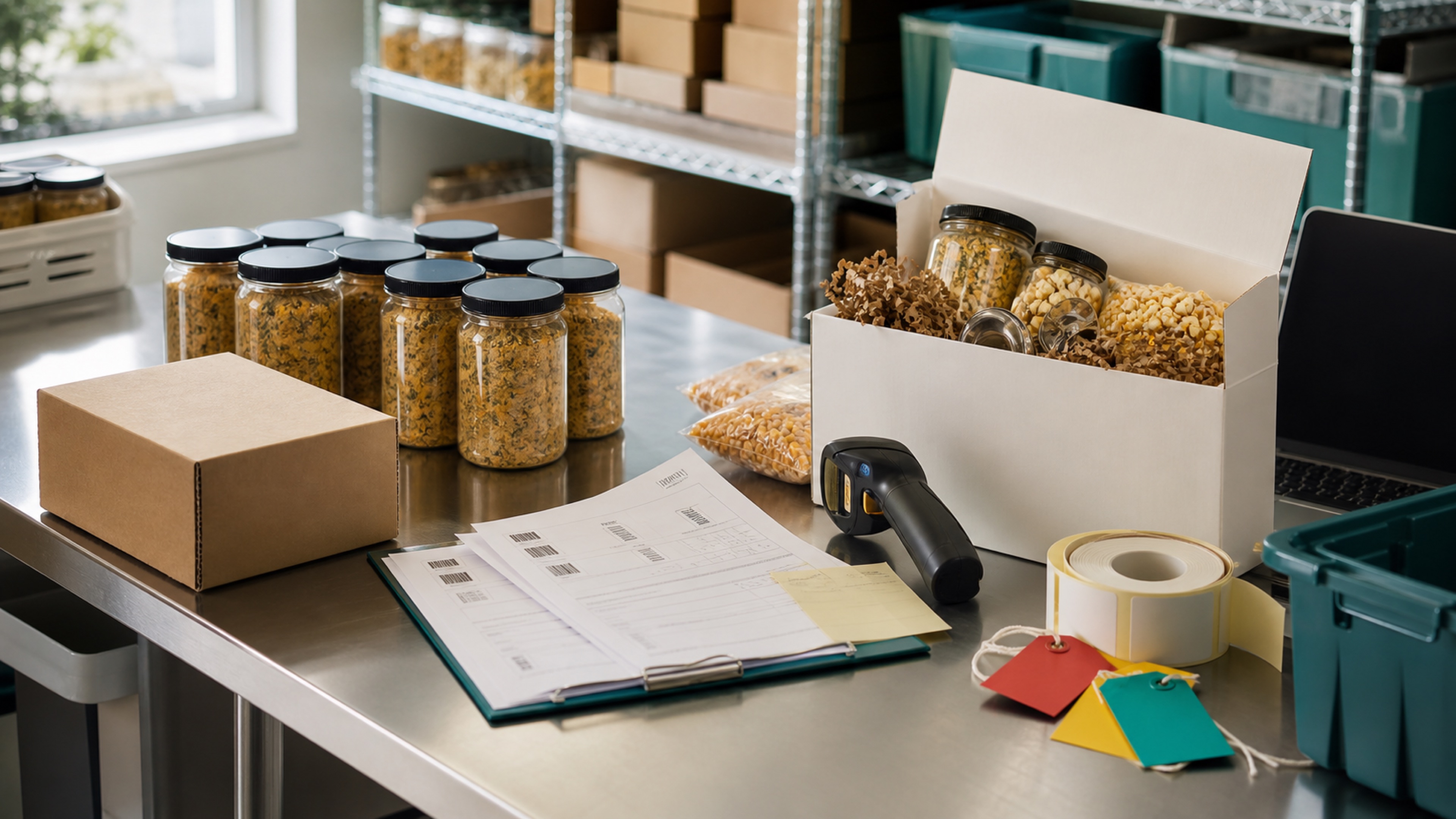
Key references: FDA's Jonco Industries recall announcement[1], the openFDA enforcement record for recall H-0890-2026[2], FDA enforcement-report definitions[3], FDA Salmonella guidance[4], and FDA's FSMA food traceability rule overview[5].
A recall that starts with seasoning supplier risk can still land in a consumer gift box, a small retail jar, a bundle, and a Shopify order history. That's where sloppy batch tracking gets expensive.
FDA's May 8 company announcement says Jonco Industries recalled certain consumer-sized White Cheddar Seasoning products because of possible Salmonella contamination. The affected consumer formats include a Williams Sonoma-branded Popcorn Sampler Gift Box component, a Fireworks Popcorn Poppings & Toppings gift set component, and Fireworks White Cheddar Seasoning in 1.6 oz jars sold at West Allis Cheese and Sausage.[1]
The openFDA enforcement record now lists recall H-0890-2026 as ongoing and Class I, with 5,200 jars total, distribution in Kansas, Minnesota, New York, and Wisconsin, recall initiation on May 1, 2026, FDA center classification on May 29, 2026, and report date June 10, 2026.[2] That date mix matters. The consumer announcement isn't brand new, but the classified enforcement record is still a useful operating signal.
The Shopify lesson is not "panic about popcorn seasoning." It is narrower and more useful: if you sell food, beverage, supplement, pet treat, cosmetics, pantry, gift-box, or private-label products, you need records that can follow a supplier issue into finished products and then into customer-facing orders.
Quick Answer
After a recall notice like this, a Shopify merchant should preserve the FDA or supplier notice, identify affected lot codes, pause sales and fulfillment for any matching product or bundle, quarantine physical stock, map affected orders, and keep a dated incident log. Do that before editing product pages, deleting SKUs, or sending broad customer emails.
For this record, the key identifiers are concrete: White Cheddar Seasoning, three affected lot codes, three consumer-facing formats, and a supplier chain involving JCB Flavors and an upstream milk powder ingredient from California Dairies.[1] Those are exactly the fields a merchant should be able to search internally.
ShelfLife fits the boring but necessary layer: expiry dates, supplier records, batch status, physical locations, and order-impact notes tied to Shopify inventory workflows. Boring is good here. Boring means the team can respond while everyone else is stressed.
What The FDA Records Say
The FDA announcement says the affected products were distributed in limited quantities through retail stores and that no illnesses had been reported at the time of the announcement.[1] The recall was initiated after Jonco Industries was notified by its seasoning supplier, JCB Flavors, of a potential Salmonella concern linked to an upstream milk powder ingredient supplied by California Dairies.[1]
The enforcement record gives the structured version of the same operational problem:
| Field | Record detail |
|---|---|
| Recall number | H-0890-2026 |
| Status | Ongoing |
| Classification | Class I |
| Recalling firm | JCB Flavors, LLC in the enforcement record; Jonco Industries in the consumer announcement |
| Consumer-facing brands | Williams Sonoma and Fireworks Popcorn formats |
| Lots | 088594-2-1, 088594-5-1, and 088594-7-1 |
| Quantity | 5,200 jars total |
| Distribution pattern | KS, MN, NY, WI |
| Reason | Products may be potentially contaminated with Salmonella |
| Report date | 2026-06-10 |
That table is the job. During a recall, nobody cares that your admin grid says "White Cheddar Seasoning" has 37 units available if the system can't tell which 37 units, which lot, which bundle, which purchase order, which fulfillment location, and which customers may be connected.
Why Class I Raises The Stakes
FDA enforcement-report definitions describe a Class I recall as a situation where there is a reasonable probability that use of, or exposure to, a violative product will cause serious adverse health consequences or death.[3] That does not mean every recall record should trigger a theatrical response. It means your process has to be precise.
FDA says Salmonella infection in people often causes gastroenteritis that can range from mild to severe, with symptoms such as fever, diarrhea, nausea, vomiting, and stomach pain.[4] For merchants, the practical rule is simple: protect customers first, preserve records second, and don't destroy the trail while trying to look fast.
The worst move is deleting a Shopify product page and calling it handled. That may stop a buyer from adding one item to cart, but it doesn't answer which customers already received the affected lot or which gift set still has that component sitting in a warehouse.
The Gift-Set Problem
This recall is a clean example of why bundles and kits make recall work harder. One seasoning component appeared in multiple consumer-facing formats: a Williams Sonoma sampler gift box, a Fireworks Popcorn gift set, and a separate 1.6 oz jar.[1]
Shopify merchants do this all the time. A hot sauce goes into a holiday box. A granola pouch goes into a breakfast sampler. A seasoning jar ships alone, in a bundle, and inside a subscription box. A cosmetic mini goes into a gift kit. The customer thinks they bought one product. Your recall system has to know the components.
If the recalled component is buried inside a gift set, SKU-level inventory is not enough. You need the relationship between component lot, assembled kit, finished SKU, and order. Without that, the recall scope expands because the team can't prove what isn't affected.
First Hour Workflow
The first hour should be containment plus evidence preservation. Move quickly. Don't improvise loudly.
- Save the FDA announcement, openFDA record, supplier notice, and any distributor email.
- Open an incident log with date, time, owner, source, and initial scope.
- Search product names, supplier names, lot codes, purchase orders, UPCs, and received dates.
- Pause sales and fulfillment for affected products, variants, bundles, subscription boxes, and wholesale packs.
- Quarantine matching physical stock by location before staff move or count it.
- Snapshot Shopify products, inventory, order exports, and fulfillment records.
- Assign one person to own record updates so the incident doesn't become a shared-document mess.
For the Jonco record, the first searches are not fuzzy: 088594-2-1, 088594-5-1, 088594-7-1, White Cheddar Seasoning, Williams Sonoma sampler, Fireworks Popcorn, JCB Flavors, and California Dairies.[1] If those fields don't exist in your records, the team is suddenly hunting through invoices, packing slips, email attachments, and memory. That's a bad Friday afternoon.
Batch Data To Keep
FDA's FSMA traceability rule does not apply to every merchant or every product. The Food Traceability List and rule have specific scope.[5] But the operating logic is still worth stealing: when a food safety issue appears, you need records that identify where product came from, what happened to it, where it went, and who received it.
A practical Shopify batch record should keep:
- supplier, manufacturer, and distributor;
- purchase order, invoice, and receiving date;
- Shopify product, variant, SKU, barcode, and bundle membership;
- supplier item number or product identifier;
- lot code, batch code, use-by date, best-by date, or expiry date;
- received quantity and current quantity by Shopify location, warehouse, or 3PL;
- batch status: active, held, quarantined, recalled, released, destroyed, returned, or refunded;
- finished kits, bundles, recipes, subscriptions, or wholesale packs that used the batch;
- order IDs and fulfillment dates that may have shipped from the batch.
Don't overbuild it into a museum. Start with the fields that answer one blunt question: which units, in which places, may have reached which customers?
Where Shopify Breaks
Shopify is good at products, variants, locations, and orders. That is not the same as recall traceability.
The recall problem lives between the objects. A supplier lot becomes a received batch. That batch gets assembled into a gift set. The gift set sits at one location and single jars sit at another. A subscription order pulls from one path. A wholesale order pulls from another. The affected component is not always visible in the top-level product title.
That is why merchants should avoid treating bundles as pure marketing. A bundle is also an operational relationship. If you can't unpack the relationship during a recall, the bundle becomes a blind spot.
How ShelfLife Helps
ShelfLife should be the place where operational facts stay connected to inventory:
- supplier and receiving records;
- lot codes and expiry dates;
- batch status and hold notes;
- locations and quantities;
- product, variant, bundle, and kit relationships;
- order export references;
- source links and internal incident notes.
The point is not to replace FDA guidance, supplier notices, legal review, or food-safety work. The point is to make the first operational search take minutes instead of hours.
ShelfLife is built for batch, expiry, supplier, and hold-status workflows so recall checks don't start from scattered spreadsheets. Use this checklist as the operating standard, then connect the records to ShelfLife when the workflow matches your store.
FAQ
What happened in the White Cheddar Seasoning recall?
FDA's company announcement says Jonco Industries recalled certain consumer-sized White Cheddar Seasoning products because they may be contaminated with Salmonella. The affected formats include Williams Sonoma and Fireworks Popcorn products, with specific lot codes listed in the FDA notice.[1]
Why does this matter for Shopify merchants?
Because a recall can move through supplier ingredients, retail jars, gift sets, subscriptions, and customer orders. A store that only tracks product quantity may not know which lot or component went into which order.
Is Shopify inventory enough for recall response?
No. Shopify inventory is useful, but recall response needs lot-level and batch-level relationships: supplier, received date, lot code, expiry date, location, product, kit, and order history.
Should merchants delete affected product pages?
No. Pause sales if needed, but preserve records. Deleting or rewriting product data can make the investigation harder.
What should merchants do first?
Save the official notice, identify affected lots, quarantine physical stock, pause relevant sales paths, export affected order data, and keep a dated incident log.
Where does ShelfLife fit?
ShelfLife helps keep expiry, batch, supplier, and inventory status records close to Shopify operations so recall checks start from structured data.
Is this legal or food-safety advice?
No. This is operational information for ecommerce teams. Product-specific recall decisions should follow FDA, supplier, legal, food-safety, and platform guidance.
Disclaimer
This article is general operational information for ecommerce merchants. It is not legal, medical, food-safety, regulatory, or recall-management advice. Always verify product-specific recall facts with FDA, your supplier, qualified counsel, and appropriate food-safety professionals before making customer, disposal, refund, or compliance decisions.
Sources
- FDA: Jonco Industries Recalls Certain Consumer-Sized White Cheddar Seasoning Products Because of Possible Health Risk
- openFDA food enforcement record: H-0890-2026
- FDA: Enforcement Report Information and Definitions
- FDA: Get the Facts about Salmonella
- FDA: FSMA Final Rule on Requirements for Additional Traceability Records for Certain Foods